Friday, August 21, 2020

Preparing for your puppy

Your puppy is coming home soon and you're ready to buy toys and dog bowls, a bed, lots of treats and more toys. But wait. What does your puppy really need? Here's a good place to start. Sizes are based on a Labrador retriever puppy. Adjust for your pup's adult size.

  • This is my favorite crate. (42” is perfect for an adult Lab)
  • This “pet yard” is the most versatile dog pen I’ve ever used. I have one in my house. It can be used to block wide doorways or as an dog pen.
  • Dog bowls - stainless steel no-tip are the best
  • 2 extra large Kongs (a must!)
  • Tricky treat ball
  • Kong Jumbler (indestructible)
  • Kong Wobbler
  • Dog food bin. You can get a bin from Target or Walmart if you like. It needs to hold at least 30 pounds of food. While you're at it, get another bin for dog toys.
  • Treat pouch. Not a requirement but helpful.
  • A 7-10 inch antler
  • Poop bags
  • 4-foot leash (get a cheap one, as your puppy will likely chew through his first)
  • Quick release martingale collar
  • A couple of tennis balls

If you plan to be out in the world with your dog, create a first aid kit. In addition to standard first aid items found in human first aid kits, add:
  • Vet wrap
  • Bag balm
  • EMT Gel
  • Benadryl
If you plan to take your puppy out in public, get a hands-free bag to use as your puppy’s go bag. Backpacks and string bags work well. You want your hands free to handle the leash and treats. For around town, include these things:
  • Poop bags
  • Clean up material: wet wipes and paper towels
  • Training treats
  • Quick drying microfiber towel for rainy days
  • Ziploc bags (gallon bags can hold soiled cleanup material until you find a trashcan or for the wet towel after you dry off your soggy dog)
  • Bottled water and a travel water bowl
For road trips, include a couple of your pup’s favorite toys, chewies (antler, raw bone), and dog food. Overnight trip? Take your pup’s crate.

You'll save a good bit of money buying online at chewy.com and Amazon rather than at the pet store. Also look into local pet consignment shops.

Thursday, November 5, 2015

Eclipse, the black Lab

Puppy Eclipse goes to boarding school

Eclipse left the only world he knew four days ago. He was one of a litter of nine black Lab puppies living in a beautiful country setting.


He didn't know what awaited him when he was plunked in a crate in my car. But he knew enough to vocalize about it.


Half an hour later I pulled into my driveway in a suburban neighborhood. Imagine his surprise at how different this new place looked, smelled and sounded. Did he wonder if his litter-mates were here, too? And why he saw no other baby puppies but three adult dogs. He wanted to engage with them immediately. Another surprise: adult boy dogs don't provide mother's milk from their under parts.


It's been a busy four days getting Eclipse acclimated to a new environment and starting crate and potty training. He had his first vet visit and was pronounced a happy, healthy puppy.

He's learning how to be on a leash and that no matter how loud he gets ..."I want out of this crate NOWWWW and I'm gonna make noise until that happens!" ... it doesn't work. I tell new puppy parents all the time: ignore puppy vocalizations that are purely attention-getting mechanisms. The noise will stop eventually. Puppies do what works. If being quiet gets the attention they want so badly, quiet will ultimately win out. And just so you'll know, I haven't entirely won that battle yet but will persevere.

Puppy Eclipse will be here for a while - until his forever family gets moved into their new home. They will do most of his training, with guidance from me. That's because Eclipse is in training to be a service dog for a very special little boy.

https://servicedogsbydee.com  

Tuesday, December 2, 2014

Heart murmurs in puppies

I was with a service dog client and her puppy for their very first vet visit. That little Labrador retriever puppy was 10 weeks old. The physical exam went smoothly. After listening to the puppy's heart, the vet said - almost in passing - that the puppy had a heart murmur. You could have heard a pin drop in that room. 

Since that experience, I have learned that juvenile heart murmurs are not unusual in puppies. I asked my vet to describe them for me, so I could share the information with you. Here is what she said:
"Basically a heart murmur is a turbulent or abnormal blood flow.  We use a scale of 1 to 6 to "grade" them based on severity.   Most puppy murmurs we run into fall into the juvenile or "innocent" murmur category.  These are soft (grade 1 or 2) murmurs that 90% of puppies will grow out of by the time they are 6 months old.  The louder, more severe murmurs (3 to 6) are more concerning in puppies as they may indicate something more severe (septal defects - hole in the heart wall, etc.)." 
I hope you never hear the words "heart murmur" associated with your own puppy. If you do, know that the odds are good that it is an issue that will resolve itself, as it did with the puppy I described above.


Thursday, November 6, 2014

Do you need a treat pouch to train your puppy?

Is your puppy food driven? A chow hound? Seemingly always hungry? If the answer is yes, I highly recommend using your pup's food drive as a motivator when training. Which means you need to have food rewards handy.

If you have pockets, keep treats in them. Otherwise, get some kind of treat pouch. There are all kinds, just google "dog treat pouches". 

One of the best treats is your dog's dry dog food. To this day (I have a four-year-old Lab), I always have kibble in my pocket. I want to reward her if she does something special - with something she loves. She's a Lab. There is no greater love for her than food. 


Here's one way to use the treats that you tote around with you all day. Use your puppy's dry dog food to train house manners. Each morning measure out a day's worth of dog food. Let's say you feed two cups a day. Feed your puppy 3/4 cup morning and evening. Put the other 1/2 cup in pocket or pouch. Use this food to reward good puppy stuff. Let's say your puppy comes running up to you and instead of jumping, sits ... looking up at you. As it's happening, be reaching for a couple of pieces of his food. That sit won't last long, so say "good sit" as you reach down with one hand to give him an "atta boy" pat while bringing your other open hand under his chin. This is so he can eat his reward right out of your hand without moving his body. As he finishes his treat, stand, tell him he's a good boy one more time and walk away. In those few seconds (it happens fast and you have to respond fast), you are teaching your baby puppy what sit means, that sit gets rewarded, and that you're paying attention. Bravo!

Saturday, January 12, 2013

Will your dog become an auto accident statistic?

Chapter 7 from Puppies chew shoes, don't they? - Driving with Your Puppy

Here are three simple rules to keep your puppy safe when you take him for rides, now and for the rest of his life.
FIRST. NEVER EVER drive on a paved road with your dog loose in the back of an open pickup truck. Ever. If you don’t get why, you should be the proud parent of a goldfish ... not a dog. Oh, and if you’re saying “hey, the dog’s on his leash back there, attached to the side of the truck, so he’s alright”. Hmm, good going. Now instead of being thrown from the truck in a collision, he’ll break his neck when you slam on the brakes. 
SECOND. NEVER EVER drive with your dog on your lap. And you say, “But Fluffy loves to help me drive”. Well then, since Fluffy is making the decisions ... has she thought this through? What happens when you are in an accident and your air bag deploys? Fluffy will either be flattened or become a small, furry projectile. I don’t know the velocity of an airborne dog but I’m guessing she’ll be flying pretty fast toward the dash or windshield. 
THIRD. IF YOU HAVE a passenger side air bag, either disarm it or put your dog in the back seat. Why? What happens when you are in an accident and your air bag deploys? Think about air bags and airborne dogs. And read the second rule again. 
Small breed dogs can be crated in your back seat, as long as the crate is anchored to the vehicle so that it does not go tumbling when you take corners too fast or brake hard. You don’t want your dog vomiting because he bounces around in the crate like he is on some insane thrill ride at the amusement park for one purpose only: to make dogs miserable. Make sure he isn’t sliding all over the place inside the crate by putting a non-skid rug (like for bathrooms) in there for him to lay on. 
Why all the fuss about where your dog rides? Because there are enough ways for dogs to be injured without their people endangering them every time they get in a vehicle. Of note: if you are involved in a collision and your doors fly open, your dog will probably run from the vehicle. He will be frightened, possibly injured and disoriented. He may wander off and get lost or be hit by another car. 

Another scenario: you are in a collision that renders you unconscious. When emergency medical personnel arrive, they are there to assist you, not your dog. If your dog is in his crate or tethered inside your vehicle, he stands a good chance of being cared for after humans are tended to. Make sure your cell phone includes an emergency contact who can take care of your dog in a situation like this.
# # #
You can’t make this stuff up. 

From my Brown Dog Blog, September 27, 2010
I’m a dog trainer. When working with a new client, I stress the importance of keeping Fido safe from injury. There are more ways dogs can get themselves in trouble than you can possibly imagine. And I’ve heard way too many of them. This email was in my box this morning. The client has an 11-month-old male Labrador retriever.The client: “We have to cancel our training for Wednesday. An unfortunate accident happened yesterday ... Bailey jumped out of the window of our car in the neighborhood and broke his femur. We don’t know what he was thinking. He is going to have surgery today for his hip and neutering and will have a 6 week recovery.”
Me: Didn’t know what he was THINKING? Seriously? He’s a dog. He was thinking, “something smells really interesting over there and I’m gonna check it out” or “there’s a dog ... I wonder if he wants to play” or a gazillion other possibilities. He had no clue jumping from a car could hurt him. He has people who are supposed to protect him from himself. 
Please, I beg of you – do NOT let your dog hang body parts out of your car.

Sunday, January 6, 2013

Are you raising a trash can dog?

Anthropomorphism. It's a big word that refers to the interpretation of animal behavior as looking like human behavior. 

How many times have you heard someone say something like "He got in the trash again. When I walked in the door he looked guilty, turned around and left the room." Guilty? Perhaps not. Here is the dog's perspective.
7:03 a.m. 
Zach is still a puppy at 10 months. He has had breakfast, a drink of water, a poo and a pee. His Mom left the house, bidding Zach a good day. Zach settles in for his morning nap.
8:45 a.m. 
Trash trucks coming. Zach wakes up, checks out the noise, woofs, gets a sip of water, goes back to sleep.
9:17 a.m.  Zach wakes up, stretches, cruises the house. Finds his tennis ball. What good is that without someone to throw it? Something moved in the corner of the bedroom. Spider. Check it out. Gone. Where'd it go? Oh well. Moves on to the kitchen. The squirrels are in the backyard. Can't get to them. Woof. Back and forth in front of the sliding glass door . SQUIRRELS! Woof woof woof. Ugh and oh well. Zach lays down, watching the backyard, falls asleep.
10:12 a.m.
Phone rings. Zach wakes up, stretches, gets a drink of water. What is that tantalizing smell? His people sometimes put yummy stuff  in that tall box in the kitchen. Fish from last night? Did they leave some in there for the dog? They are SO good to him. Zach knocks the trash can over and starts the most fun game of the day: a treasure hunt. Finds the fishy smelling paper towel, eats it; finds the potato peelings, eats them; finds the mostly empty chocolate pudding container, licks it clean. Not much else of interest. Another sip of water and a nap on the couch.

Fast forward to 5:48 p.m.
Mom gets home from work to find the contents of the trashcan all over the kitchen floor. Zach greets her as always, tail wagging. But wait. He takes one look at her body language and knows she is not happy. Why? Did she have a bad day? She's yelling at him. Why? Her hands are all fisted and she's wearing her mad face. Zach tries to figure out what's going on when she yells "Bad dog" in her really mean voice. Zach gets the heck out of there as fast as he can. 
When telling a friend about the the latest trashcan incident, Mom will swear Zach knew he'd done something wrong because he looked guilty.
Zach lives in the now. He got into the trash hours ago. It was self-rewarding. He connects his owner's anger with her homecoming not with the scattered trash. Do you really want to teach your dog to stop joyously greeting you at the door? Of course not. You want him to stay out of the trash.

There are lots of training solutions for trash-eating dogs. But let's keep it simple. Remove the source of the problem. And the problem is not the dog. Put the trashcan somewhere Zach can't get to it. AND provide Zach with a richer daily life so he doesn't go looking for something to do. Consider a dog walker, doggy day care, interactive toys, and perhaps even another dog to keep Zach company.

Understand your dog's motivation, body language, and responses to his environment and you can successfully address any issues you may have with him. Can you think of times when you may have misunderstood your dog?


Monday, December 3, 2012

Warning: Puppy on the Loose!

This is an excerpt from Chapter 1 of Puppies chew shoes, don't they?

 
Your puppy arrived five minutes ago. You plunked the little darling in the middle of the floor for all to adore and ... he peed. You admire the fact that his plumbing works. He turns, snags your pant leg (it was the closest thing to him) and pulls. You screech, laugh, and disengage puppy from your clothing.

Fast forward a few weeks and Cute Adorable Puppy has used your entire house as a toilet, pooping and peeing wherever he chooses. He has destroyed two books, a shoe, the remote, your favorite Rolling Stones CD, most of a pillow, three rolls of toilet paper, and is working on gnawing through the legs of your dining room table. Do you have a bad puppy? A stupid puppy? A normal puppy? 

Answers: No. Probably not. Yes.

So what’s up with all this? To start with, your puppy:
  • Came to this unfamiliar place – your home – without his mom or siblings and he’s adjusting
  • Doesn’t know what “go potty” means (language again)
  • Has no idea what language you’re speaking (think English-speaking American in Moscow, trying to understand Russian)
  • Hasn’t a clue what a collar and leash are, much less why he’s forced to wear them
  • Sleeps, plays, poops, pees, eats ... and then does it all over again
  • Is a baby, so cut him some slack
# # #

Time to rewind the tape. Your new puppy will arrive in a week. What should a responsible pet parent do to prepare? 

Puppy-proof your house. Get on your hands and knees to look at your house from a puppy’s perspective. Even if you tether your puppy to you and properly crate train him, sometime in his youth he will escape your watchful eye and destroy something you are fond of – if it is within his reach. Starting now, make sure “it” isn’t within his reach.

Since you have been warned, when your puppy rips apart a pair of $100 shoes, here’s what you do: roll up a newspaper and smack yourself upside the head. It’s YOUR fault, not his! Why? Because Rule #3 is: "If it fits in his mouth and he can reach it, it will go in his mouth". And there are teeth in there. Sharp ones that can destroy an amazing array of your things. So the answer to the question “Puppies chew shoes, don’t they?” is ... absolutely! In addition to shoes, puppies will happily chew:
  • Computer cables and electric cords
  • Articles of clothing (dirty laundry is a puppy favorite)
  • Sporting equipment
  • Children’s toys
  • Books, magazines, newspapers, DVDs, CDs, homework
  • Fingers, arms, toes, legs
  • Other family pets
  • Pant legs and chair legs
  • Remote controls
  • iPhones, iPods, & other iStuff
  • Eye glasses
  • Leashes and collars
  • Contents of litter boxes (dog candy)
  • Food of any kind – dog, cat, bird, gerbil, fish, human
  • Plants (warning: some houseplants are toxic to dogs)
  • Anything at puppy nose level
What to do to prevent total destruction of your worldly possessions? 

For starters, there should be a gate at every stairway. Google “baby gates” to find gates that will work in your home. Next, choose a room where puppy is allowed (kitchens often work well) and close doors to all other rooms. Use baby gates to block access to areas without a door.
Puppy should have limited access to your home until he is old enough to exhibit self-control. How old is that? For some puppies it will be around six months – when teething is finished. For others it will be sometime in young adulthood. For still others, the day may never come. Know your puppy. If you try allowing him to roam your downstairs alone when he’s seven months old and he destroys something ... you have acted too soon. 

Oh, and all trash cans should be out of reach. Raiding them is self-rewarding for a puppy and once he has experienced trash can delights, it’s challenging to get him to stop.

Outdoors. If you have a pool, make sure the puppy cannot get in it without supervision. Introduce puppy to your pool carefully, showing him how to get out, as well as how to get in. Those stairs are obvious to you but not to your puppy. Puppies have no depth perception, which is why one will occasionally try to walk on water. This can result in a very surprised puppy when he is suddenly under water. It can also result in a scared puppy who may never go near water of any kind again (think beach vacation). So ease him into the pool supporting his chest and belly. A floating long line attached to his collar will insure his safety. Swimming is one of the best ways to exercise your puppy, so make his first pool experience a happy one.

Yards are full of things puppies like to investigate. Make sure anything poisonous (fertilizer, antifreeze, etc.) is out of reach. If your yard is fenced in, make sure there are no spaces a puppy can squeeze through. Put the gardening tools away. Their handles make wonderful chew toys. Understand that if you have a yard, your new pal may dig holes, bed down in the flowers, chew the corners off of your deck steps, and bark at everything from butterflies to falling leaves. He may eat dirt and rocks and parts of trees. He is, after all, a puppy. 

# #  #

Friday, November 30, 2012

The bell on the door

Potty training your puppy is a challenge. Clear communication between you and him will make the process easier. If you teach your puppy to ring a bell attached to a door, he can tell you every time he needs to go out. Here are the steps:

  1. Take your puppy out the same door every time you take him outside for a potty break. Within a couple of days, he will know that when that particular door opens, he gets to go outside - which most puppies love to do. Most likely he will start gravitating toward that door when he has to go potty.
  2. Get a bell. It doesn't have to be anything fancy, only something loud enough for you to hear throughout your house. And don't make it so big your puppy can't easily set it ringing with paw or nose.
  3. Hang the bell on the "go outside" door knob at puppy-nose-height. Or hang it on a hook on the wall or even from the ceiling. The only thing that matters is that your puppy can see the bell as he approaches the door and can ring it with paw or nose without jumping.
  4. When you get ready to take your puppy outside for a potty break, put on his leash, approach the door, and jingle the bell(s). Your puppy, being the curious sort, will most likely touch the bell with his nose. If he does (even if it doesn't ring), open the door and your happiest voice, with a spring in your step, take puppy with you, telling him he is brilliant for ringing the bell. In most cases, the only reward he will need is being outside with his person.
  5. Repeat until your puppy rings the bell on his own.


    This "cow bell" (above) is a bell worn by hunting dogs on their collars and works well as an inexpensive "bell on the door". Attach with twine.

    And then there are the designer versions - lots of options available online. 

    # # #

Protect those puppy paws

The pads on your puppy’s paws are tender. Musher’s Secret or dog booties will protect those pads on hot sand or pavement during summer, as well as the extreme cold in the winter.

Winter warning: Products that can clear a sidewalk of ice can be toxic to your puppy. And since puppies lick their pads to clean them, wipe those paws thoroughly after a walk outside on the sidewalk, street or parking lot. Use pet, child, and environment friendly ice melt around your home.

# # #

Tuesday, November 27, 2012

Crates

There are many different kinds of dog crates. The two most popular in the U.S. are the wire crate and the molded plastic crate. If you want to buy only one crate that will work from puppyhood to adulthood, get a wire crate made for the approximate size your puppy will be when he grows up. Get one with a divider and at least two doors, one on the end and one on the side. Adjust the divider forward in the crate to allow puppy only enough room to stand up, turn around, and lay down. Too much room and he may use one end of the crate as bedroom, the other as a bathroom.

Molded plastic and soft crates can be good for travel. Wait for that soft crate until your puppy is complete crate trained. Otherwise he will likely eat or claw his way out. There are even wooden covers for crates that make them look like a piece of furniture. Google "dog crates" and you will find much to choose from. Ian Dunbar, the famous trainer/behaviorist, crate trains using Kongs. Get a free download of his book, Before You Get Your Puppy and After You Get Your Puppy online at Dog Star Daily. 

TIP: Google "pet products consignment store" with your city and state. If there is one of these near you, savings can be significant and anything your puppy no longer needs can be resold. 

 WARNING: Always remove puppy’s leash and collar before crating to prevent choking.


Above is an example of a wire crate with two doors.


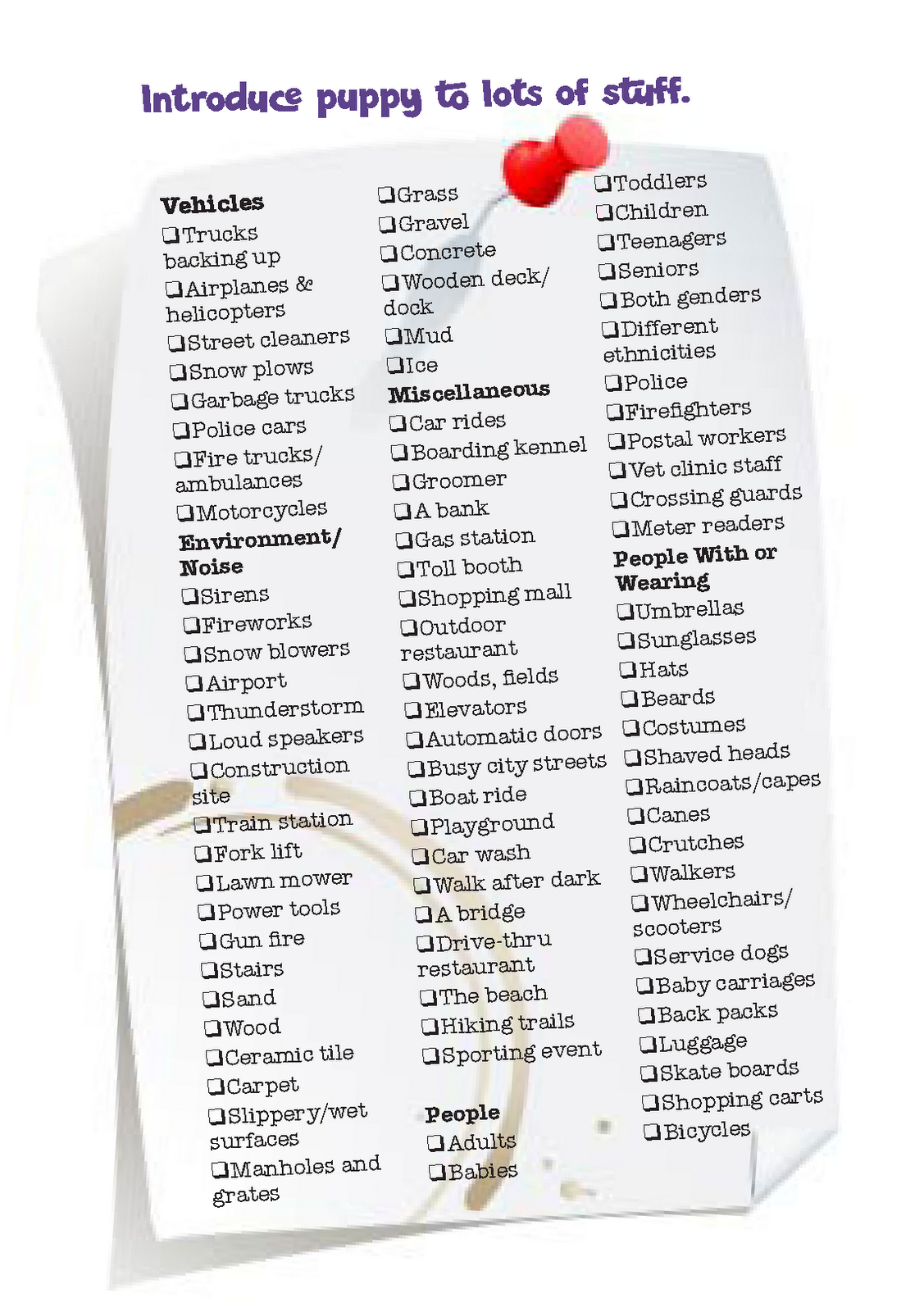
Introduce puppy to everything!

Your puppy needs to be socialized with all kinds of people early on. He also needs to experience the world outside his own home so that larger world does not frighten him. Here's a checklist to get you started.

Harnesses

Sometimes it's all about the gear. One of the best solutions for puppies who pull is a front-connecting body harness. A couple of good ones are the Halti and the Sensation.

The key to success with both of these harnesses is that the leash is attached to a ring on the chest. Why is that important? Because it's the puppy's center of gravity. Uses? These harnesses are great for small people with big dogs, dogs with neck injuries, and dogs for whom nothing else works (including head collars).

A body harness does not replace a well trained puppy. If you do not have a positive dog trainer in your life, find one in your geographic area through the Association of Pet Dog Trainers.


Google "dog harnesses" or pick one up at the nearest pet store.
Do you have a story about your puppy and his harness? A picture of him wearing one? Send it along so we can share it with our readers. Woof!

Martingale Collars

The day that I saw a frightened German shepherd back out of her collar in a pet store, run at full speed to the front of the store, and fly out through the automatic doors straight into a busy parking lot - that was the day I started recommending martingale collars.

A martingale is comfortable for your puppy while keeping him secure on leash. It is made with two loops. The large loop goes over your puppy's head and onto his neck. Then the puppy's leash attaches to the ring on the small loop. When the martingale is fitted properly, your puppy will not be able to back out of it. The tension on the leash pulls the small loop tight, which makes the large loop smaller and tighter (but not too tight) on the neck. The following image shows how the two loops on a martingale collar work.


For a standard buckle collar to be tight enough so it can't slip over a puppy's  ears, it may well have to be uncomfortably tight on puppy 's neck. The martingale collar allows your puppy to wear a collar that is only tight when it needs to be.

Should you leave a martingale collar on  your puppy all the time? No. All collars can be potentially dangerous because of the risk of the puppy getting hung up on something and choking. Plus, puppies have been known to chew a martingale off. I recommend a break-away buckle collar your puppy at all times except when he is crated or kenneled. When the leash comes out, the martingale goes on. In fact, my dog's martingale stays attached to his leash all the time.

May all your outings with your puppy be fun and safe!


 Google "martingale collars" or pick one up at the nearest pet store.
Do you have a story about your puppy and his martingale collar? A picture of him wearing one? Send it along so we can share it with our readers. Woof!

Sunday, November 25, 2012

Baby gates

Baby gates are a great way to keep your puppy from wandering all over your home - when he's too young to do it safely. They are great to block access to stairs, kids' playrooms, rooms within open floor plans, etc. There are all kinds of gates in a wide range of prices. They can be spring loaded, mountable or free standing, made of wood, metal or plastic.

Read more about puppy safety in Puppies chew shoes, don't they?

  Google "baby gates" for lots of options.

Break-Away Collars

Rather than a standard buckle collar, start your puppy off with a break-away buckle collar. Choking and strangulation are very real concern for puppy parents. Puppy playtime can turn into tragedy if a puppy's regular collar gets caught on something like:
  • steps, gates, fences, and decks
  • shrubbery
  • kennels and crates
  • air conditioning/heating units, vents
  • another dog's jaw (they wrestle and play and one dog's jaw gets caught in the other dog's collar)
The beauty of the break-away collar is that the buckle releases when pressure is applied. Used properly it does double duty as a collar you can attach puppy's leash to. Here's an example: the KeepSafe.

Think this can't happen to your dog? Listen to this episode of Bark Radio called "Not Ready for the Rainbow Bridge."


Do you have a story about a puppy and his break-away collar. Send it along so we can share it with our readers. Woof!


Saturday, November 24, 2012

Ho, Ho, Ho ... Scary Christmas?

Your holidays may include a picture-taking event for your puppy or dog - perhaps one that includes the guy in the red suit. If this is something new to your dog, watch his body language. If upon seeing Santa your dog starts backing up or barking or tries to run away, he may be afraid. Don't force him to have his picture taken with someone who scares him. Cut him some slack. Take him to the park instead. 

And consider this: rather than paying for a portrait with Santa, give generously to a local doggy rescue group. Santa will be pleased.

Friday, November 23, 2012

Exercise Pens

If you are reading Puppies chew shoes, don't they? for Kindle, this post goes with Chapter 2.

Exercise pens are a good way to contain your puppy. They come in lots of sizes, heights, and materials. Some you can use outside: you garden, puppy plays safely in his exercise pen. Make sure you get a size appropriate to your dog's breed. Google "exercise pens" for a big selection.

Here are three examples.

Wire.

Plastic.
Soft-sided.
 Woofs 'n wags!

Thursday, November 15, 2012

Kindle edition coming soon!

Puppies chew shoes is a great gift for anyone getting a puppy. Soon it will be available through Amazon and readable on your iPad, Kindle, or iPhone.


Choosing a veterinarian

If you are reading Puppies chew shoes, don't they? on a Kindle, this post goes with Chapter 1.


Many dog owners know only one dog professional ... their vet. Make certain that you trust yours enough to put your puppy's life in her hands. To help choose the right vet for you and your puppy:
  1. Look into an accredited American Animal Hospital Association (AAHA) vet clinic near you. I recommend AAHA vets because as a service dog trainer, I have accompanied families nationwide on that first puppy wellness visit. Across the board, AAHA accredited vets were consistent in their knowledge of veterinary medicine and offered appropriate recommendations for socialization, toys, training, etc. Because they have to follow standards set down by the accrediting agency, the vets seem to be those who continue their education and are, therefore, up on the latest best practices.
  2. Consider an integrative/holistic vet. Learn all about this approach to keeping your dog healthy for life at the Veterinary Institute of Integrative Medicine
  3. For complex medical issues or for a second opinion, know where to find local veterinary specialists. Start with the AVMA American Board of Veterinary Specialists.
When you take your puppy the first time, make sure your puppy is comfortable with your vet. Personally, I also want friendly, helpful people at the front desk and I want to be able to call my vet with questions and not be put off.

To better understand your dog's health issues, the one of the best online resource for articles and videos is Dr. Karen Becker's Healthy Pets website.

Keep that smile on your puppy's face with good health for life!

The Fabulous Furminator


Note: If you are reading Puppies chew shoes, don't they? on a Kindle, this post goes with Chapter 1.

Lots of Labrador retrievers live at my house. They have double coats. They shed. Year 'round. The only grooming tool I need for my furry beasts is the Furminator. The company calls it a de-shedding tool. I call it amazing.