- Take your puppy out the same door every time you take him outside for a potty break. Within a couple of days, he will know that when that particular door opens, he gets to go outside - which most puppies love to do. Most likely he will start gravitating toward that door when he has to go potty.
- Get a bell. It doesn't have to be anything fancy, only something loud enough for you to hear throughout your house. And don't make it so big your puppy can't easily set it ringing with paw or nose.
- Hang the bell on the "go outside" door knob at puppy-nose-height. Or hang it on a hook on the wall or even from the ceiling. The only thing that matters is that your puppy can see the bell as he approaches the door and can ring it with paw or nose without jumping.
- When you get ready to take your puppy outside for a potty break, put on his leash, approach the door, and jingle the bell(s). Your puppy, being the curious sort, will most likely touch the bell with his nose. If he does (even if it doesn't ring), open the door and your happiest voice, with a spring in your step, take puppy with you, telling him he is brilliant for ringing the bell. In most cases, the only reward he will need is being outside with his person.
- Repeat until your puppy rings the bell on his own.
 This "cow bell" (above) is a bell worn by hunting dogs on their collars and works well as an inexpensive "bell on the door". Attach with twine.
 And then there are the designer versions - lots of options available online.# # #

Friday, November 30, 2012
The bell on the door
Potty training your puppy is a challenge. Clear communication between you and him will make the process easier. If you teach your puppy to ring a bell attached to a door, he can tell you every time he needs to go out. Here are the steps:


Protect those puppy paws
The pads on your puppy’s paws are tender. Musher’s Secret or dog booties will protect those pads on hot sand or pavement during summer, as well as the extreme cold in the winter.
Winter warning: Products that can clear a sidewalk of ice can be toxic to your puppy. And since puppies lick their pads to clean them, wipe those paws thoroughly after a walk outside on the sidewalk, street or parking lot. Use pet, child, and environment friendly ice melt around your home.
 # # #
Winter warning: Products that can clear a sidewalk of ice can be toxic to your puppy. And since puppies lick their pads to clean them, wipe those paws thoroughly after a walk outside on the sidewalk, street or parking lot. Use pet, child, and environment friendly ice melt around your home.

Tuesday, November 27, 2012
Crates
There are many different kinds of dog crates. The two most popular in the U.S. are the wire crate and the molded plastic crate. If you want to buy only one crate that will work from puppyhood to adulthood, get a wire crate made for the approximate size your puppy will be when he grows up. Get one with a divider and at least two doors, one on the end and one on the side. Adjust the divider forward in the crate to allow puppy only enough room to stand up, turn around, and lay down.
Too much room and he may use one end of the crate as bedroom, the other as a bathroom.
Molded plastic and soft crates can be good for travel. Wait for that soft crate until your puppy is complete crate trained. Otherwise he will likely eat or claw his way out. There are even wooden covers for crates that make them look like a piece of furniture. Google "dog crates" and you will find much to choose from. Ian Dunbar, the famous trainer/behaviorist, crate trains using Kongs. Get a free download of his book, Before You Get Your Puppy and After You Get Your Puppy online at Dog Star Daily.
TIP: Google "pet products consignment store" with your city and state. If there is one of these near you, savings can be significant and anything your puppy no longer needs can be resold.
WARNING: Always remove puppy’s leash and collar before crating to prevent choking.

Above is an example of a wire crate with two doors.
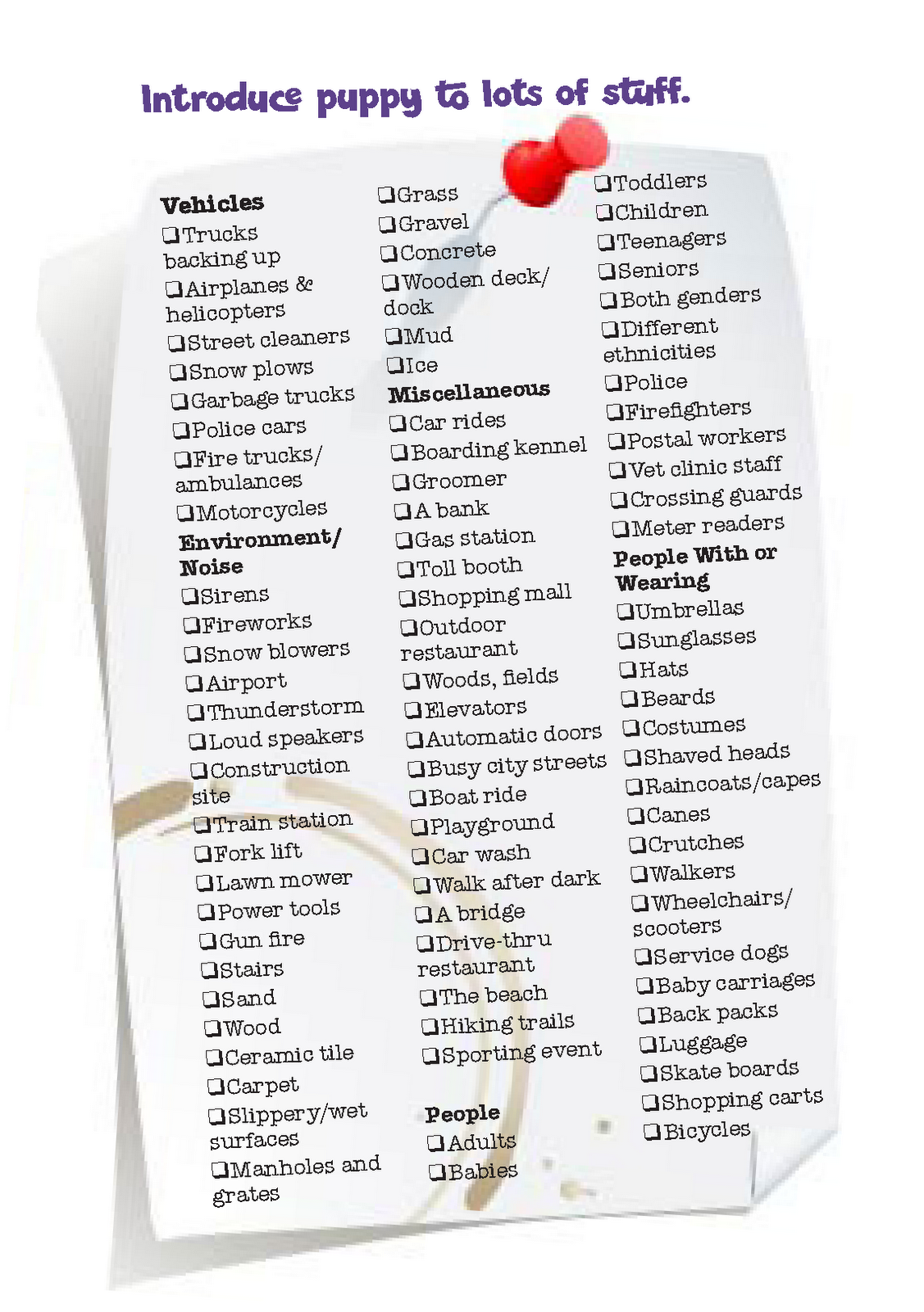
Introduce puppy to everything!
Your puppy needs to be socialized with all kinds of people early on. He also needs to experience the world outside his own home so that larger world does not frighten him. Here's a checklist to get you started.

Harnesses
Sometimes it's all about the gear. One of the best solutions for puppies
who pull is a front-connecting body harness. A couple of good ones are
the Halti and the Sensation.
The key to success with both of these harnesses is that the leash is attached to a ring on the chest. Why is that important? Because it's the puppy's center of gravity. Uses? These harnesses are great for small people with big dogs, dogs with neck injuries, and dogs for whom nothing else works (including head collars).
A body harness does not replace a well trained puppy. If you do not have a positive dog trainer in your life, find one in your geographic area through the Association of Pet Dog Trainers.
Google "dog harnesses" or pick one up at the nearest pet store.
Do you have a story about your puppy and his harness? A picture of him wearing one? Send it along so we can share it with our readers. Woof!
Martingale Collars
The day that I saw a frightened German shepherd back out of her
collar in a pet store, run at full speed to the front of the store, and fly
out through the automatic doors straight into a busy parking lot -
that was the day I started recommending martingale collars.
A martingale is comfortable for your puppy while keeping him secure on leash. It is made with two loops. The large loop goes over your puppy's head and onto his neck. Then the puppy's leash attaches to the ring on the small loop. When the martingale is fitted properly, your puppy will not be able to back out of it. The tension on the leash pulls the small loop tight, which makes the large loop smaller and tighter (but not too tight) on the neck. The following image shows how the two loops on a martingale collar work.

For a standard buckle collar to be tight enough so it can't slip over a puppy's ears, it may well have to be uncomfortably tight on puppy 's neck. The martingale collar allows your puppy to wear a collar that is only tight when it needs to be.
Should you leave a martingale collar on your puppy all the time? No. All collars can be potentially dangerous because of the risk of the puppy getting hung up on something and choking. Plus, puppies have been known to chew a martingale off. I recommend a break-away buckle collar your puppy at all times except when he is crated or kenneled. When the leash comes out, the martingale goes on. In fact, my dog's martingale stays attached to his leash all the time.
May all your outings with your puppy be fun and safe!

Google "martingale collars" or pick one up at the nearest pet store.
Do you have a story about your puppy and his martingale collar? A picture of him wearing one? Send it along so we can share it with our readers. Woof!
Sunday, November 25, 2012
Baby gates
Baby gates are a great way to keep your puppy from wandering all over your home - when he's too young to do it safely. They are great to block access to stairs, kids' playrooms, rooms within open floor plans, etc. There are all kinds of gates in a wide range of prices. They can be spring loaded, mountable or free standing, made of wood, metal or plastic.
Read more about puppy safety in Puppies chew shoes, don't they?

Read more about puppy safety in Puppies chew shoes, don't they?

Google "baby gates" for lots of options.
Subscribe to:
Posts (Atom)